Showing posts with label Yamaguchi. Show all posts

Tuesday, February 11, 2014

Stone in Love With Akiyoshido Cave


山口県美祢市秋芳洞 Akiyoshido Cave, Mine City, Yamaguchi Prefecture

(BGM: "Caverna Magica" by Andreas Vollenweider) 

(If you haven't already, please read Caving In To Akiyoshido before this. Thanks!)

With one arm bathed in sunlight and the other covered in a shawl of darkness, I paused by the calming Migawari Kannon statue to pick up my jaw from off the floor. I knew from the sinister, pointy stalactite hanging over my head that everything I would see for the next few hours was going to kick my proverbial butt with inspiration. My heart raced as fast as the water gushing loudly beneath my feet, knowing I would have to leave a part of it behind. (Caves and I go way back; I could always be found in our high school art room painting them. I never thought in my wildest dreams that I would actually get the chance to walk inside a real one!) This was definitely going to be the journey of a lifetime!


The Official Bit About Where We Are:
Special Natural Monument Akiyoshido, located 100 meters beneath Akiyoshidai Quasi-National Park, is Japan's largest limestone cave at an impressive 10km long (only 0.9km is open to the public) and up to 100 meters wide. This archaeologically significant cave system has produced both Pleistocene age fossils and Paleolithic artifacts. It's also home to some unique lifeforms found only in the region, such as horseshoe bats, a neon pink bug with a really long name and Shikokuyokoebi shrimp. (More about the scientific wonders of Akiyoshido can be found here on Karusuto.com's Japanese site).

The biggest attractions are no doubt the countless ancient, alien speleothems in a wide variety of bizarre shapes and colors dotting the entire course, the bigger ones dating tens of thousands of years. There are 26 main points of interest, conveniently grouped into 13 stations, each one offering a recorded English description at the push of a button.

Disclaimer: I promised myself this time around that I would enjoy this cave more with my naked eyes than through the restrictive lens of a camera. For this reason, some of the 26 points are missing. Since photos never do a place justice, I'm hoping Readers will simply come visit Akiyoshido to fill in the blanks. But just in case that's not possible, 12 of the 13 stations are shown here in this blog.

So with no further ado, let's dive in!

Point 1: 秋芳洞入り口 (Akiyoshido Iriguchi, Cave Entrance)

Goodbye, fresh air and sunshine!

Once the pupils adjust to the darkness, faint colors become visible again with the help of white LED lights. The flowstone oozing out of the cave walls here closely resembles creamy peanut butter. I reached out to touch it, but my hand came back dry! No fair!


My favorite environments have always been free-form and symbiotic, flowing and sporadic. Nature moves this way, in a harmonious relationship philosopher Alan Watts might call "prickles and goo." What better examples of "prickles and goo" than prickly stalactites and gooey flowstone formations!

A fine, "gooey" example of flowstone.
At my left stood a ticket machine. For an extra 300 yen, wanna-be "spelunkers" could climb and crawl around a separate, slippery course to see the actual mechanism of the cave more closely. (The course looked too tough to attempt in heavy winter gear, so we decided to save it for next time).

Point 2: 青天井 (Aotenjou, Blue Ceiling)

The name comes from the effect of light streaming in from the cave's mouth, causing the water below to reflect that light onto the white ceiling above. Apparently the minerals here lend the said bluish hue. This trick is now accomplished with the help of more white lighting. I thought I could detect splotches of pale glacier-blue light here and there, but other tourists will probably tell you it still looks white to them. Either way, I was very glad to see natural lighting. While other photos I found online showed Akiyoshido awash in gaudy, garish colors, the lighting here allowed me to appreciate the natural beauty of the minerals, which were lovely enough without artificial enhancement.

That bright white spot on the ceiling is really blue.

Point 3: 長淵 (Nagafuchi, Long Abyss)

The water is as still as glass, here. Reflections go undisturbed.

Once past the falls, the torrent quiets down, allowing for the enjoyment of more delicate sounds. Echos grow deeper with such exaggerated reverb that footsteps and children's giggles become one indistinguishable noise. Suddenly the ceiling lifts and spreads out into an upside-down lunar landscape while the water flattens into a wide, reflective mirror below. A burnt orange band of rust creates an unexpected warmth in contrast to the cool greys of the limestone. The spaciousness of this expansive natural hallway took away any claustrophobic feelings I was experiencing. This was the perfect place for a brief repose.


Point 4: 百枚皿 (Hyakumaizara, Hundred Saucers)


This formation is perhaps the most famous speleothem associated with Akiyoshido Cave. As the name suggests, this massive sinter terrace, softly spilling over with a continuous flow of water, gives the impression of a hundred (more like five hundred) plates stacked up high. The rainbow-like bands of natural mineral color reflecting in each pool create an illusion of continuity when viewed from certain angles. I did as the guide suggested and squinted my eyes in the hopes of finding tiny crystalline, blind shrimp darting around inside the pools. Occasionally, the water's surface would indeed ripple for me. But I couldn't tell if the source of movement came from within, or from the stalactites dripping overhead. I could really feel my creative juices flowing as I stood and reveled next to this fantastic display of natural art. 


Point 5: 広庭「洞内富士」 (Hironiwa, "Donai Fuji," Expansive Yard, "Mt. Fuji of the Caverns")


Across from Hyakumaizara looms this vibrantly colored, towering pile of chalky white limestone that strangely resembles Roy's mashed potato rendition of Devil's Tower (from Close Encounters of the Third Kind), but with gravy (flowstone) poured on one side. Water dripping from the ceiling caused this mountain to form from the ground up (technically making it a gargantuan stalagmite). This single speleothem really drove home for me the ability of water to transport dissolved minerals. 


すぼ柿 (Subogaki, Straw-Wrapped Persimmon)


Though it looks more like fecal matter, the red-striped oval blob of flowstone in the middle of this photograph is said to resemble the dried fruit of its namesake. (Can you spot it?) Other "produce" found growing within the flowstone at the foot of this "Mt. Fuji" include pumpkins and pine mushrooms. 

Point 6: 千町田 (Chimachida, Thousand Rice Fields)

Which way is up, again?

The lights that normally shine on this feature must have been turned off for some reason, for this elegant collection of rimstone pools was too hard to see by naked eye or camera flash. But the comforting dark more than made up for it. Though this particular speleothem takes up less space than Hyakumaizara, the individual pools are wider and shallower, giving a more spacious appearance. The undisturbed water perfectly mirrored the thousands of stalactites dangling from above, disorienting like a house of mirrors at a summer carnival.

Point 7: 傘づくし (Kasazukushi, Hanging Umbrellas)
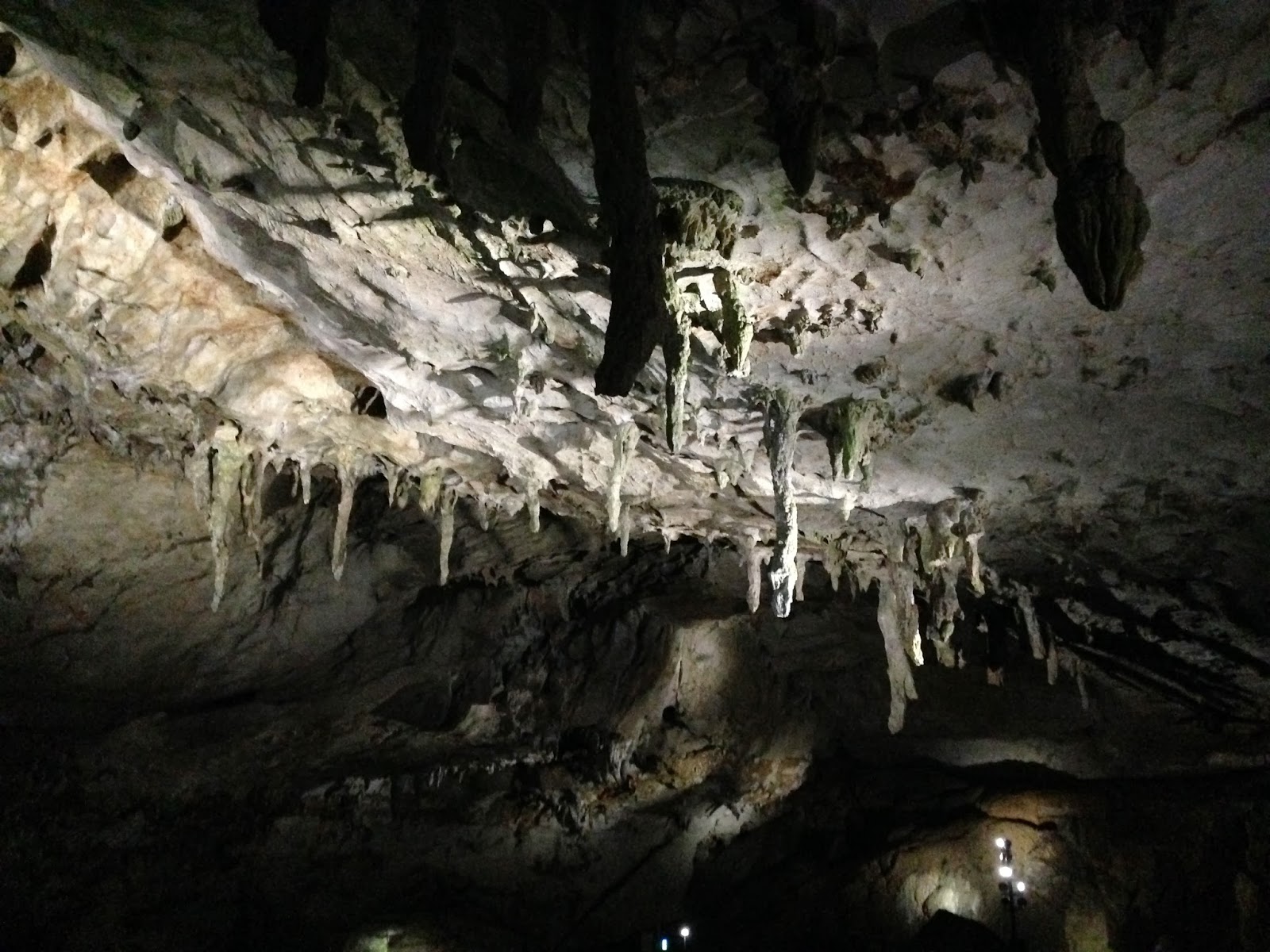

I personally think they resemble icicles more than the handles of folded-up bamboo parasols as the name suggests. Nonetheless, I found this stalactite garden both mesmerizing and frightening! But thanks to the strategic placing of the walking trails, we could enjoy the cave without any fear of being impaled to death by a falling limestone javelin. The concave shape of the ceiling made me wonder if I was standing directly underneath one of the 500 sinkholes of the Akiyoshidai Karst Plateau above me.

Point 8: 大黒柱 (Daikokubashira, King Pillar)


A romantic example of a stalagnat (column), this is what happens when stalactites and stalagmites fall in love and hook up. This particular pillar took around 15,000 years to form (considering it takes 200 years for stalactites to grow 3cm and twice as many years for stalagmites to grow the same amount).

 Point 9: 千畳敷 (Senjoujiki, Thousand Tatami Mats)


In Japanese culture, the floorspace of an enclosed room is often measured by how many tatami mats can fit inside it. This area is 120 meters wide and the eye is supposed to be able to see as far as 200 meters forward at this spot. But in the pitch black of the cave, vision soon disappears into utter darkness while the imagination takes over. Without a map, though, it's hard to tell which ends are dead ends. A huge pile of rock stands in the middle of this space, where part of the cave collapsed in a geological event aeons ago.


Shifting my focus to the aluminum lake-blue water crashing over the rocks below, I found myself in awe of the original spelunkers who first came out here to survey this magnificent subterranean garden. Equipped with only hard hats, climbing gear and flashlights, they must have slipped and tripped their way in the dark, making note of each misstep and wowing at every spectacle.

Walking up a flight of steps, I noticed a long cue of people waiting for an elevator that took them up through the ground to the Akiyoshidai Karst Observation Deck. We debated it only for a second, however. A treasure trove of eerie formations still awaited our discovery. Putting them off was not an option!

空滝 (Karataki, Dry Fall)

I could just imagine this gorgeous flowstone above ground edged with pansies and ferns!


Point 10: 黄金柱 (Koganebashira, Golden Pillar)

Saint Peter? Where are you?

Yet another brief hike of steep limestone stairs and the cave narrows into a majestic, bronzed corridor with this glittering golden pillar as the undeniable centerpiece. The other natural wonder associated with Akiyoshido Cave, Koganebashira stands like a giant candle at a regal 15 meters (49 feet) tall and 4 meters (13 feet) across, dwarfing all who come walking past it. I nearly hyperventilated here, the impact of this piece was just too great! Had we just arrived at the gates of Heaven? 

Point 11: 巌窟王 (Gankutsuou, The Count of Monte Cristo or "King of the Cave")


Akiyoshido Cave keeps an average year-round temperature of 17C (62.6F). I was bundled up in turtlenecks and wool for outside temps of zero degrees. But by this point in the 1km-high hike, I was ready to rip everything off. Here where the walls feel particularly close, I wiped the sweat off my eyes with my scarf only to behold this terrifying stone monster, cloaked in a shadow of evil. Mustering the courage to inspect it, from one side it looked like a fearsome demon king from the depths of Hades. But walking around it only 45 degrees, out popped this square-headed character with a disproportionate nose and a few protrusions unaccounted for! Never once did the classic novel by Alexandre Dumas come across my mind as I saw this. But I was filled with reverent awe over the fact that this stalagmite took over 100,000 years to form! The age of it, alone suddenly turned this grotesque, nondescript chunk of rock into a thing of beauty in my mind. I felt humbled.


At this point in the journey, the sound of the rushing river had long gone, leaving each footstep to echo and finally dissolve into delicious infinity. Safe in this ancient cathedral of rusty reds and chocolate browns, I felt the spontaneous urge to test the acoustics of the cave, enraptured in what I could only define as a "holy moment." Each note of "Amazing Grace" I uttered ricocheted countless times off the rocks and quickly escaped into unknown crevasses like frightened fish. If it weren't for the tour group shuffling in ahead of me, I would've kept on singing. The rich reverberation sounded incredible!

くらげの滝のぼり (Kuragenotakinobori, Jelly Fish Climbing Upwards)


石灰華の滝 (Sekkaika no Taki, Limestone Flower Falls)
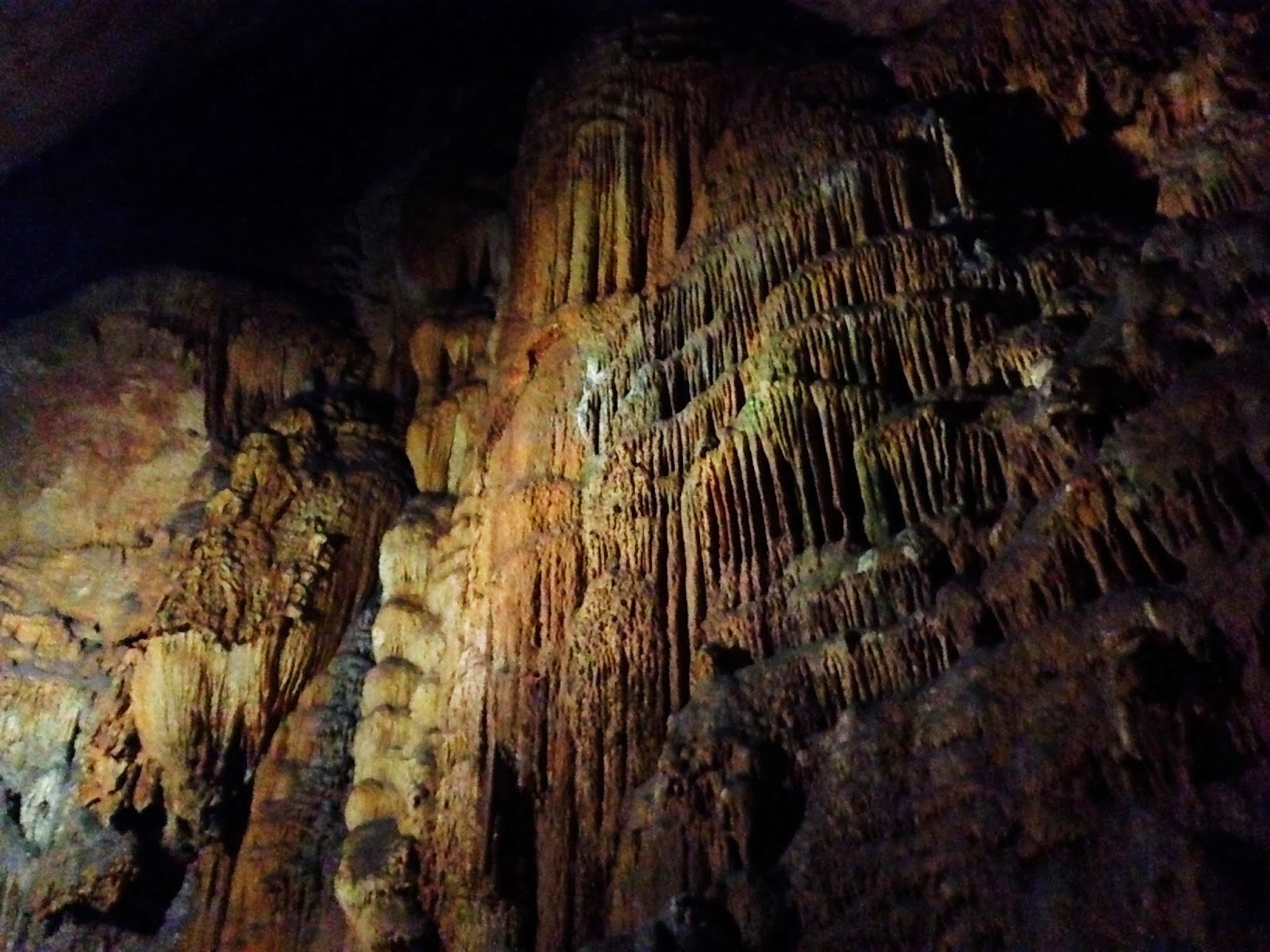

This is my absolute favorite stretch of Akiyoshido Cave, where the walls look like they've been splashed with buckets of plaster, gesso and paint, all scratched and raked with forks and knives. I could've spent hours in this section alone, trying to figure out how the flowstone spilled over each protrusion in the rock beneath.

Point 12: 五月雨御殿 (Samidaregoten, Rain Palace)


黒谷入り口 (Kurotani iriguchi, Black Valley Entrance)

This stalactite and stalagmite couple used to be joined, but were separated when the ground shifted downward in a geological event long ago. Separated by a mere 4 centimeters, they are expected to rejoin in another 400-500 years, providing the ground stays quiet for that long. (The wait must be unbearable for them).

Point 13: マリア観音 (Maria Kannon, The Goddess of Mercy)

Too blinded by sweat at this point to see well, the totem pole stalagmite "Maria Kannon," which somewhat resembles a human figure, didn't catch my attention. Rather, my mind only registered the steel "cage" built around it for protection. In my exhaustion, I must've thought it was an electric power generator. (For the curious, a photo of Maria Kannon can be found here).


Just when I least expected it, the path abruptly smoothed out and we were back into the square walled Rubic's Cube world of human "civilization." We ascended an upward sloping straightaway tunnel twinkling with dreamy New-Age music and brightly painted murals on both walls. The scenes depicted the cave's journey through time, starting with the formation of the earth and the emergence of dinosaurs to the discovery of Akiyoshido and the fossils within. Had we not been completely famished, I would have taken more photos of it.

But already, I was missing the organically flowing genius that previously surrounded me. I felt a pain inside my soul, like I'd just been in the presence of a great love I knew I would have to leave. The sudden switch from the random fluidity of blobs, spikes and curves to the predictable world of squares and lines reminded me of something Alan Watts once said:  

"Nature is wiggly, everything wiggles...You know wherever human beings have been around and done their thing, you'll find rectangles; we live in boxes."  

It made me desire a modern culture that celebrates the supple curves of nature instead of one that always tries to "straighten her out." Akiyoshido felt both comfortable and stimulating to me, setting me ablaze with a passion to learn more about the earth's subterranean secrets.

And just like that, we unceremoniously popped back out into the brightness of day, panting from our exhaustive 1km upward climb. Cold, refreshing spruce and cedar air stung our grateful lungs as we breathed in deep, desperate gulps. Squinting and blinking, it was all my husband and I could do but to laugh together, amazed by the surreal paradise we had just emerged from.

A great part of me is still inside the cave, lost and poking around in wonderment. I'm quite happy to have left a piece of my heart at Akiyoshido. It means that someday, I have to return there to pick it up.


Akiyoshido Cave Access Information:
Open Hours: 8:30am to 4:30pm
Closed/Holidays: None. Open 365 days/year
Transportation Access: 
(By Bus): Take the Bocho Bus from Shin Yamaguchi Station to Akiyoshido (45 minutes one-way, 1140 yen), or the JR Bus from Yamaguchi Station (55 minutes, 1180 yen).
(By Car): 15 minutes from Mine I.C. (Interchange) or 12 minutes from Jyumonji I.C.
Admission Fee (Group rate discounts are available):
Adult & High School Students: 1,200 yen
Junior High School Students: 950 yen
Elementary School Students: 600 yen
Approximate Touring Time of Akiyoshido Cave: 40 minutes to 1 hour
Available Facilities Inside Akiyoshido: Electronic tour guide in both English and Japanese, hand rails for stairs, wheelchair access (for part of the cave), all-LED eco-lighting, staff inside the cave available for assistance, elevator access
Available Facilities Outside Akiyoshido: restrooms, taxi services, gift shops, drink vending machines
Other Caves in the Area:  Taishodo Cave and Kagekiyodo Cave

Copyright 2014 Genkilee, Gen. All rights reserved. No part of this blog (written or photo content) may be reproduced or reprinted without the expressed permission of the author. 


Tuesday, February 4, 2014

Caving In to Akiyoshido (Mine City, Yamaguchi Prefecture)

山口県美祢市秋芳洞 Akiyoshido Cave, Mine City, Yamaguchi Prefecture

(BGM: "The Cave" by Mumford & Sons)

Too full of childlike anticipation to sleep, I spent the entire night on the Internet, researching the wonders of Akiyoshido cave, making a Christmas list for myself of photos I wanted to take. If it was anything like the beauty above ground, we were in for a real treat! The three cups of hotel coffee sloshing around in my gut and the hot can of Royal Milk Tea warming up my hand were enough to keep any tiredness at bay. I was raring to go!


We rolled into Akiyoshido, a single intersection of streets in the middle of farm country with a hotel and a collection of shops. That was it.


Right on cue as our car clock rolled 10:00am, parking lot ticket-takers, bundled up tight in the chilly morning air, waved their arms at us frantically, trying to lure us in. Fortunately for us, the night before on our way back from Akiyoshidai Park, we spotted a very cheap alternative to the 500-yen slots they were offering! And it used the honor system to boot! Just park and put your 100-yen coin in the red can provided! How hassle-free could you get?

Cheapest parking at Akiyoshido. It pays to arrive here early!
Ignoring the disappointed scowls of the parking attendants, we strode confidently down the hill onto the main cobblestone promenade that led to the cave's entrance. 

Apparently the town has resident kappa (humanoids with turtle shells on their backs and a thing for cucumbers and sake. Think Mutant Ninja Turtles minus the swords and knee pads). The water trickling in the ditch beside me didn't look deep or clean enough to support the kind of ecosystem kappa prefer, but okay.
 
I think this kappa wins the staring contest.
Prayers for the indigenous lifeforms of Akiyoshido including bats, shrimp and kappa.
Half of the stores were closed for the New Year's holiday. The few that were open offered an eclectic combination of purple and brown granny fashions, marble nicknacks and prayer beads, soft ice cream and local pottery.

Items made from local (and imported) yellow marble and a nondescript blob of stalagmite.

Stone chunks, prayer beads and other trinkets for sale (next to a rice paddy, of course).
Just when we thought things couldn't get any more random, we met this gentleman:

The Best Happa Mushi Maker in Akiyoshi! "Mr. H." :-)
It was the middle of winter and here he was selling origami katydids folded out of blades of grass. (Katydids and green grass are usually summer items). None of it made any sense. None, whatsoever (which made it all irresistible to me, or perhaps it was the coffee buzz I was on).

"Happa Mushi" (leaf bugs) for sale! Handmade! :-)
As soon as he noticed me, his face burst into a wide, friendly smile and he immediately switched  languages, giving me his full attention. Half a decade ago, I used to get upset whenever Japanese people would automatically assume I spoke this language or that, just by looking at my face. But after years of banging my head painfully against this particular cultural brick wall, I learned to recognize the arrogance of my thinking. 

Now, instead of getting defensive and preachy against the evils of racial profiling, I praise the few who do try to speak English. After all, it must take them tremendous courage to go against a centuries-old monoculture by reaching out to me, a foreigner. I see this for the honest gift it is, not a display of ignorance.

"Miss, what do you call this in English?" Mr. H. asked me in a smooth American accent, laced with a smidgeon of German.

Uh, a grasshopper?

"Close! A grass grasshopper!" (HA HA HA HA HA!)

"Grass Grasshoppers!" :-D
Mr. H. was so full of these cute little jokes and one-liners that he seemed to echo the playfulness of the whimsical katydids he peddled. They were so lifelike, I did a double-take when I saw them. Slitting a hole into a blade of grass with a knife, he explained how his grass grasshoppers needed to be bought by the pair lest they get lonely, and that they live at least ten years, much longer than real ones. He didn't have to try to sell so hard, though. His genuine warmth had already sealed the deal. Without hesitation, we bought two as he suggested.

(He gave me full permission to use his name and photos on my blog, bless his heart!)
Reveling at the delicate artistry of his curious creations, we stood there with him in the street for what must have been at least twenty minutes, laughing and sharing stories of our travels. Just as we suspected, he'd visited much of the Western world (including Europe) and did all sorts of cool, fun things with his life. He spoke to us as equals, without a hint of condescension or apprehension. Right away he gave me his full name when I asked it, a rare thing in his culture! It was encouraging to be around someone so used to our mannerisms and ways of expression. I'm sure it's people like him, not the government's billion-yen effort at globalizing the nation, that are gradually steering the country away from its xenophobia. (But I digress...)

He had to remind us about the cave, we were having too much fun talking! He carefully placed one katydid in a plastic container with a lid on top and asked us to carry the other on a leaf for him, to advertise his business as we walked around town. We agreed and with a warm handshake and a friendly "farewell," we grinned and giggled our way to the end of the street with this insect bobbing up and down in time to my steps. We relished the smiles the other tourists gave us upon seeing our unseasonal new pet. Joy always begets joy.

The entrance to the Akiyoshido ticket booth.

Though the loudspeakers were blaring full-on, it was still too early for the cave to be inundated with busloads of tour groups, so we were processed quickly and easily. All paid up and with English brochures in hand, we walked on through the bright, Ueno Station-like gate and back out into...


...a fragrant cedar forest rushing with the music of flowing water?! (Could this trip get any weirder?) Had we suddenly stepped through the magic tunnel of Miyazaki Hayao's anime Sen to Chihiro no Kamikakushi (Spirited Away) or did we just stumble through a wormhole?

After a few deep-breathing exercises, we followed the melodious staccato of the river upstream and were halted in our tracks by a towering wall of pale gray limestone rock that made our jaws literally drop to the floor. My heart was beating so fast, I thought I was going to faint! 

We stood there utterly speechless, beholding the womb of Mother Earth, mighty and gushing afterbirth right there before our eyes. As my husband grinned ear-to-ear like a Cheshire cat, I blushed from a fleeting moment of inadequacy, feeling somewhat outdone. (Again, I digress...)

(No comment)
Like a little boy at the gate to Disneyland, my husband hurried on ahead of me as I tried to digitally capture the intense phthalocyanine blue of the pool below us. Stepping up onto the platform, I could feel the force of the water vibrating the scaffolding beneath my feet. The rush was exhilarating!


Higher and higher we climbed, until stalactites hovered menacingly over our heads. We were about to be swallowed up whole!


No sooner had I turned a corner into complete darkness than a blast of warm air hit my face, heavy and chalky with the reek of ancient dried-out seashells. The acoustics of the cave amplified the roaring of the waterfall into a deafening noise that played havoc with my equilibrium. Moved nearly to tears by the overwhelming forces of nature, I stopped to catch my breath at a bodhisattva for before proceeding. Heaven help me, indeed! I was about to go in deep!


Looking back the way we came, doubts began to invade my mind. What if there was a sudden earthquake and the entrance was sealed shut? What if I fell down into a crevasse, never to be found again?

Or what if I fell helplessly in love with this place and never wanted to leave? 

Stay tuned for more adventures at Akiyoshido Cave!

Copyright 2014 Genkilee, Gen. All rights reserved. No part of this blog (written or photo content) may be reproduced or reprinted without the expressed permission of the author. 


Wednesday, January 29, 2014

Pampas Grass and Pinnacles: Akiyoshidai Quasi-National Park

山口県美祢市秋吉台国定公園 Akiyoshidai Quasi-National Park, Mine City, Yamaguchi Pref.

(BGM: "Africa" by Toto)

Akiyoshidai Quasi-National Park (秋吉台国定公園, Akiyoshidai Kokutei Kouen), on the outskirts of Mine City in Yamaguchi Prefecture, is Japan's most well-known example of karst topography. (Karst is landscape formed when underlying limestone is eroded by dissolution). Though karst can be found elsewhere in Japan and throughout the world, Akiyoshidai Park features some real geological gems, such as Japan's largest limestone cave Akiyoshido (秋芳洞), an endless supply of limestone pinnacles, and as the official pamphlet suggests, "the most concentration of doline (sinkholes) in the world." To fully comprehend and appreciate the natural wizardry behind the making of this park, an entire day is recommended to explore Akiyoshidai inside and out.

My husband and I were planning on doing just that, but couldn't due to our tight itinerary. (We started our journey three hours later than we'd hoped). We arrived just minutes before sundown at the parking lot next to the Karst Observatory, which was just getting ready to close. We had hoped to tour the park by our portable bikes, but masses of rock jutted out of the trail like outcrops of mushrooms and the intense, hilly terrain made leisurely cruising an impossibility. Neither of us were in the mood for an obstacle course, so we left the bikes folded up in the car and set out on foot. 


The dusk slowly covered us in pink light as we hiked away from the crowds into the chilly wind, out towards a seemingly endless space that led absolutely nowhere (45.02 square kilometers of nowhere, to be exact).

Um...this doesn't look like Japan, anymore.
I just couldn't believe my eyes. The sudden impact of all this open countryside left me absolutely speechless. It dawned on me just how accustomed I'd become to both the mental and physical confinement of island life, all these years.

Setting our smart phone cameras to panorama, we savored the 360-degree view as the land scrolled out before us, limited only by our imaginations. An occasional scraggly tree broke the void, each standing lost and lonely, like friends separated by their teacher for goofing off in class. A memory of the treeless tundra near the Arctic Circle flashed through my mind, and for awhile there, I was transported home, again. My husband, on the other hand, was reminded of safari videos of the Serengeti Plains he'd seen on YouTube.

"I bless the rains down in..." Wait a minute!
Faced with a choice of routes, we chose a trail that led us head-on into a polije (enclosed depression). Standing in the middle of it looking up at this gigantic, curving wall of earth surrounding me, I felt like a tiny crumb in an empty cereal bowl. The sensation of smallness was delightfully addictive!


We continued down the switchback path, intrigued by the plethora of alien, bluish-grey limestone pinnacles everywhere that seemed so out of place. Some reached up to our knees while others towered high overhead. Many of them were streaked with finger-width vertical grooves from top to base. Still others had scorch marks which gave them an almost igneous appearance. Had the rocks been deliberately defaced by tourists?

A limestone pinnacle carved by water and time.
A quick Internet search revealed that the entire terrain of Akiyoshidai, like the miles of caves beneath our feet, was once a giant underwater mass of limestone reef. As time and cataclysm pushed it all up above sea level, millenniums' worth of rain eroded the exposed limestone, carving unique patterns onto the pinnacles. 

This rain, combined with groundwater activity, also dissolved the limestone beneath the topsoil, causing it to collapse in places. This is how Akiyoshidai's many sinkholes (doline or uvale) were formed. (An impressive photo gallery of doline, pinnacles and displays of karst around the world are beautifully depicted here on Dusky Wondersite). As awe-inspiring as they can be, doline are actually quite notorious, especially in parts of Florida, for swallowing up entire houses and destroying expensive infrastructure. Perhaps for this reason, only a fraction of Akiyoshidai is open to the public, possibly to avoid dangerous situations like this.

Though the idea of falling through the ground and disappearing forever is somewhat unnerving, these particular doline were structurally sound enough to serve as garden beds for the locals as far back as the Jomon period (12,000-300 BC), according to artifacts found around the largest doline in the area, Nagashakuri Uvale (ナガシャクリ・ウバーレ).

Trails winding around and plunging deep into Nagashakuri Uvale (ナガシャクリ・ウバーレ).
Which begs the question: if this area was used for agriculture, why is the land out here so barren, now? Why do we only see this unforgiving expanse of grass and low shrubbery? 


The cedar forests surrounding the park hold the key to this mystery. Littered with more pinnacles than trees, these forests provide a picture of how Akiyoshidai used to look before humans tamed it. Decades of controlled burning and the porous nature of the soil assured that the trees here once cut would never grow back. The crusty topsoil proved better suited to pampas grass cultivation, which provided grazing for cattle and thatch for roofs. In a way, the landscape we see here now could be labeled "man-made," but the clear-cutting does allow for the land to take on a soothing, undulating rhythm, making it possible for the pinnacles to receive their due attention, each one a monument to the artistic forces of nature.

Pinnacles with Pampas Grass (Miscanthus sinensis)
Akiyoshidai changes her attire to correspond with the seasons. Fires set intentionally to the grass in late winter add nutrients to the soil, allowing for spring wildflowers to bloom. Summer brings a cooling contrast of greens, grays and blues, while winter blankets the landscape in sparkling snow. I was grateful to see Akiyoshidai in the off-season, while the warmth of autumn tones still lent their richness to the scenery despite the January chill. 

As darkness softly crept over the land, we wandered around listlessly in the deafening silence, relishing every fleeting second of it. The only sound we could hear was the wind pushing gently through the long, feathery pampas grass, rustling like a horsehair brush on a cymbal. The sharper the temperature dropped, the louder the grass rattled, signaling that it was time for us to go.


We regretted not having enough time to learn more about this amazing place at the nearby Akiyoshidai Science Museum (秋吉台科学博物館, Akiyoshidai Kagaku Hakubutsukan). But we vowed to come back here again during operating hours to fully explore all that this park has to offer. Meanwhile, untold wonders of indescribable beauty and strangeness silently awaited our discovery, hundreds of meters beneath our feet. Like the rain that dissolves the stone, we had only, quite literally, scratched the surface of Akiyoshidai Quasi-National Park.


Akiyoshidai Quasi-National Park Information

Open Hours: Akiyoshidai Park is open all hours. The museum and observatory are open from 8:30am to 4:30pm.
Holidays: The park is open 365 days a year. 
Access By Car: 15 minutes via Mine I.C. or 12 minutes from Jyumonji I.C.
Access By Bus: 1 hr from Yamaguchi Station. 40 minutes from Shinkansen Shinyamaguchi Station. 25 minutes from Mine Station. 
Facilities Available:  Drink vending machines, public restrooms, a small restaurant/gift shop are located near the Karst Observatory. Picnic tables and benches dot the hiking trails.
Parking: Free parking at designated sites around the park. 


  Copyright 2014 Genkilee, Gen. All rights reserved. No part of this blog (written or photo content) may be reproduced or reprinted without the expressed permission of the author.