Showing posts with label B. Early Spring. Show all posts

Saturday, March 1, 2014

6. 草木萌動, "Vegetation Sprouts, Trees Bud"

(BGM:  "The Way We're Going" by Michael Tomlinson)

Shichijuni-kou (72 Seasons) Calendar Listing
初春, Shoshun: "Early Spring"
Season No. 2: 雨水, Usui: "Rain Water" 

Perched high atop Mt. Ryou in Mihara City, overlooking the Seto Inland Sea, the Hubby and I spent the day reflecting on how we survived our first year in Hiroshima. While communing with a row of gracefully leaning moss-covered sakura trees still quiet in their final month's repose, my heart skipped a beat as the spirited whistles of the uguisu (Japanese bush warbler) broke the silence, echoing playfully across the mountain range. Spring had arrived with the gift of song!

View of Mt. Fudekake from Mt. Ryuo (Mihara, Hiroshima)
Enshrouded in the thick, billowing mists curling around the mountains, we were unable to see anything past a kilometer into the distance. The faint outline of a single island was all we could make out from so high up, so we concentrated instead on savoring the replenishing moist air filling our lungs. The coastline drive along Route 2 provided us with a slightly clearer view of the island-studded sea.

"Islands in the Mists" (Tadanoumi Town, Takehara City)
Climate No. 6: 草木萌動
Soumoku Mebae Izuru:
" Vegetation Sprouts, Trees Bud" 
(March 1-4)

"Counting them as I pass: 
   House after house, 
    The plums and willows."  
                 -Matsuo Basho

"New Life Reaching Out"

And so it begins. The mountains slowly, sensuously slip into a yellow-green dress of moist, new branches.


A willow's furry new mittens.

Willow and magnolia trees coyly flaunt supple catkin mittens as soft as rabbit fur. This is Spring's slow striptease to build excitement before the main event. Grey thrushes, varied tits and brown-eared bulbuls strike up a chorus, now that the bush warbler has finally taken his rightful place at center stage.

Brown-eared Bulbul (Hypsipetes amaurotis) in Sakura Buds. (Copyright 2013, Gen, All Rights Reserved)

Taste of the Season: 山独活, Yamaudo, Japanese Spikenard (aka "Mountain Asparagus")
  
Yama udo!  What in Sam Hill? This is food?


It sat there lonely in the supermarket display basket, practically begging me to take it home. I knew that some of the most amazing tastes could be found in the most hideous of packages, so I wasn't going to just write this little guy off. I picked up the long, staff-like udo (Aralia cordata) and brought it close to my face. Getting a nose full of the exposed buds, they smelled faintly citrus like lemongrass with the sharp zing of pine needles. I was intrigued! My husband had seen them before in Korean supermarkets and suggested I give it a whirl. Good thing he has a sense of adventure!

I found a simple recipe online for kimpira udo. Sliding it carefully out from its plastic bag, this gnarly, tentacled thing looked less like a vegetable and more like the creepy alien hand that copped a feel of Ann Robinson in the 1953 classic War of the Worlds. Apprehension took hold of me as I saw it lying there exposed and vulnerable on my cold, stainless steel kitchen counter like a patient waiting for surgery. Did I really want to go through with this procedure?

"EEEEEEK!!!"

Spikenard rots quickly after harvest, so I had to work fast. Brown slime stuck to the base of the bag and I feared an allergic reaction should it contact my sensitive skin. I quickly chopped off the bad bits and threw them into the garbage. Dissecting the stem was an easier process, revealing an appealing shimmering white, crisp flesh similar in texture to the lower stalk of a leek. I carefully slivered the udo as directed and tossed it into a bath of ice water spiked with sushi vinegar to cure it. 

As I fried them in a tiny bit of sesame oil and dried red chili, I noticed the udo slices shrinking and softening to resemble flat udon noodles. Desperate to revive them like the surgeons working on E.T., I added soy sauce, mirin, sake and sesame seeds STAT. Yet after all that cooking, my 1.5 cups of raw slivered udo had shrunk into three heaping tablespoons worth of food. My hopes deflated like a whoopie cushion. 

3 Tablespoons of Meh

Upon first bite, the greatly anticipated lemony fragrance had completely vanished, leaving behind a faint woodsy, medicinal aftertaste like that of fresh panax ginseng. And that was it! For a hard-earned 300 yen, that was it! I can't even say that it tasted "good."

So at my husband's advice, I chucked the vegetable into a bowl of rice along with a dollop of spicy hot kochujang pepper paste and a pack of bibimbap mix. Five minutes of continuous stirring and the mixed rice was good enough to cover the bland, lifeless taste of the udo.

Korean bibimbap  rice with udo.

About five chews into my meal, I suddenly felt guilty, like I'd killed it, the way Ann Robinson showed remorse (I'm guessing) when she saw the blood of the alien after Gene Barry clubbed it to death. If I'd only tried to understand it better, if I'd only reached out to feel its pain...

The udo would not forgive me, however, and I spent the next two days buckled in stomach pain from an allergic reaction to the vengeful plant. As with any toxic relationship that's more give than take, sometimes, the best thing is to just let go, and walk away. Duly noted.

Copyright 2014 Genkilee, Gen. All rights reserved. No part of this blog (written or photo content) may be reproduced or reprinted without the expressed permission of the author.


Friday, February 28, 2014

5. 霞始靆, "Mist Hangs Over the Land"

(BGM:  Nanohana Ressha by Kikuchi Madoka)

Shichijuni-kou (72 Seasons) Calendar Listing
初春, Shoshun: Early Spring
Season No. 2: 雨水, Usui: Rain Water

Raindrops Cling to Narcissus (Hiroshima Prefecture)
 Climate No. 5: 霞始靆, Kasumi Wa Hajimete Tanabiku: 
Mist Hangs Over the Land (February 24-28)

"It is spring!
  A hill without a name
   In thin haze."   -Matsuo Basho

Stepping outside to face this morning's sun, I found that the the distant mountains had blended in with the horizon, glazed over with a gossamer whitish haze. It wasn't cedar pollen, pollution or smoke messing with my eyes. Nor was it yellow sand blowing in from China creating the illusion that the mountains were floating over the hills. The warm, moist air of morning had wrapped us all in a wispy gauze of spring mist the Japanese call kasumi  (霞).


Kasumi  can roll in thick or thin. However it comes, this bewitching spring mist can bring some serious silhouettes to an early spring landscape.


As the warmth of the sun gradually teased more moisture out of the ground and nearby river, things started to get a little steamy at my place of work. Condensation on the walls and windows usually meant cold rain was pouring down outside. But this time, the air had no winter sting!


As much as I want this heat wave to stick around, however, I realize that it's now the time of sankanshion (三寒四温), where we get three cold days for every four not-so-cold days. Sure the repetition of extremes takes a hard toll on the body. But if it means no longer having to buy boxes of kairo hand warmer packs, it's all good!

Tradition of the Season: 野焼き, Noyaki, Controlled Burning

Noyaki Sunset, Ohmi Hachiman, Shiga Prefecture (C) Oppa, 2011, All Rights Reserved
I remember how I used to panic whenever I saw thick black smoke billowing from the fields of Ibaraki every February. I kept thinking I should call the fire brigade! 


House On Fire? (Tsukubamirai City, Ibaraki, 2009)
One day my former boss (who also just happened to be my organic rice supplier) informed me with a giggle that farmers in Japan burn their fields every spring to control pests, kill off weeds and return nutrients to tired soil before early summer planting. In certain parts of the country, whole communities make a day's festival out of noyaki  (possibly to shorten coughing time), with neighbors helping each other start and corral the flames.

Burning grasses in the river bed (Takehara, Hiroshima)
From February to April, entire mountainsides go up in an inferno of hellfire, charring the landscape jet black and littering nearby village roofs with snow-like ash. Nobody complains, however, as the burning off of lifeless matter remains a time-honored form of spiritual purification in both Buddhist and Shinto rituals, bringing luck and protection from divine forces. The burning of the fields is a joyous occasion, a time to celebrate! Some notable noyaki  festivals include Akiyoshidai in Yamaguchi Prefecture, the Dai Himonjiyaki/Noyaki Festival on the slopes of Kyushu's active Mt. Aso volcano and the burning of Mt. Ogi in Beppu City, Oita Prefecture.

Whenever I drive by a smoking noyaki in progress, I quickly roll down the car window to grab a whiff. The warm, musty smoke from the burning of old leaves and underbrush reminds me of the salmon smokehouses that dot the riverbanks of my Alaskan homeland. In Japan, noyaki  is a traditional symbol of seasonal change, cleansing both land and mind. Since noyaki  is an essential element of Japanese organic farming, as my former boss once pointed out, the practice doesn't seem to be a tradition that will 'burn out' anytime soon, despite global concern for rising CO2 levels. (Sorry, Readers. I couldn't resist).

Taste of the Season: 菜の花, 菜花 Nanohana, Nabana, Rapeseed


Nanohana Field (Kusatsu, Shiga Prefecture)

Spring Wave (Tsukubamirai City, Ibaraki)
While on my first grocery shopping trip in Japan, I was frustrated by the utter lack of things made from corn. In the States, corn is virtually inescapable, as the film Food, Inc. so effectively brings to light. It's in our breads, our meats, our drinks, even in our medicines! Raised on Mexicali and Tex-Mex food, I was nearly destroyed when I found only frozen nan bread in the market freezer where corn tortillas should be. Surely with all the corn Japan imports from the US, corn oil would be the standard cooking fat of choice, right?

Nope. The cheapest and most plentiful oil here is canola, made from rapeseed (Brassica napus). Mustering up the courage to try something new, I decided to give canola oil a whirl in my Sapporo dorm kitchen. As I savored the crispy golden crust of a simple egg fried sunny side up, I marveled at how the oil cooked up clean without leaving any annoying corn odor on my hair or clothing! It also made my Asian food taste worlds better than the heavy slop I always turned out on my stove back in the States. My corn oil days were gone forever!


While driving down a monotonous suburban Japanese highway, the sudden flash of neon-yellow nanohana in full bloom can be so shocking in the brown dead of winter that one needs to be careful not to run off the road! Their fragrance is almost sickeningly sweet, like a cross between honeysuckle and dandelion. Despite their heavy scent, the flowers, leaves and stems of the nanohana are eaten as a vegetable in Japan, usually mixed into rice or steamed as a side green. The taste is mellow and creamy, like spinach but with a natural buttery aftertaste that smooths out any trace of bitterness.

Nanohana can easily be purchased in supermarkets and mom & pop groceries. But in my experience, most aunties plodding around their fields will be more than happy to pluck for you a few stems if you express interest in trying it out. Just a quick steam or flash-boil and sprinkle with a teeny bit of salt is all it takes for a pleasant addition to your spring repertoire! 

Copyright 2014 Robynn. All rights reserved. No part of this blog (written or photo content) may be reproduced or reprinted without the expressed permission of the author.


Sunday, February 23, 2014

4. 土脉潤起, "Soil Becomes Moist"

(BGM:  "春よ、来い Haruyo Koi , Longing for Spring" by Yumi Matsutouya)

Shichijuni-kou (72 Seasons) Calendar Listing
初春, Shoshun: "Early Spring"
Season No. 2: 雨水, Usui: "Rain Water" 

The sunlight shines on my mountain earlier now, its soft pink and orange glow warming me with my morning coffee. Glancing at my weather app, however, I see rain in the weekly forecast with day temperatures peaking over 10C. It looks like the snows of winter will be replaced by the chilly yet nourishing rains of spring. We're ready for them! The earth is thirsty! Last year from Hokuriku to Chugoku, we had no shortage of February rain. Will this year be the same?

"Sweeping In the Rain" (Kenrokuen Garden, Ishikawa Prefecture, February 2013)

 Climate No. 4: 土脉潤起, Tsuchi no Shou Uruoi Okoru: 
"Soil Becomes Moist" (February 19-23)

The morning mirror shows my hair kinky and curly from humidity that rolled in with the warm air currents overnight. Rain that fell days before still remains stored here and there in tiny puddles around our driveway. The ground is saturated.

The kids will have to wait a little longer...

Sprouts and critters sleeping below no longer have an excuse to remain hidden underground. I can almost hear everyone stirring around with the same excitement of stagehands rustling behind a velvet curtain, scrambling as they prepare the set for the opening act. The tension is nothing short of delicious! Haruyo koi! Hayaku koi!  ("Come, springtime! Hurry!")

Taste of the Season: 蓬, Yomogi, Mugwort

"Spring rain- 
  Mugwort spreading out
    Among the roadside grass" -Matsuo Basho

In my peripheral vision, I spot a small carpet of mixed greens next to the street gutter and what do I behold?

Chinese Mugwort (Artemisia princeps)


Mugwort! Mugwort! Spring has sprung!!

Has Gen gone bonkers? Possibly. But I really LOVE this herb! Back in the day, I used to dry silvery green bundles of wild Artemisia alaskana ("Alaska wormwood") and add sachets of it to my bathwater for its stimulating fragrance and medicinal properties. I was delighted to learn that the artemisia found in Japan and Korea is just as cherished for its many uses.

Growing in thick patches along highways and hillsides, this common herb is still highly coveted as both a healing agent and a flavoring for sweets. Drugstores and kampo (Chinese herbal medicine) shops across Japan still carry yomogi  tea, bath salts, moxibustion cones and skin salves. Its comforting menthol and camphor-like zing improves circulation, soothes cracked, chilled skin and helps to open congested sinuses.

A huge bath sachet full of locally-grown mugwort (Yujin no Yu Hot Springs, Onomichi, Hiroshima)

But my favorite way of enjoying yomogi  is in a chewy, delicately sweetened kusamochi  (草もち)rice cake. Fresh young yomogi  leaves are finely blended into a puree and mixed with sticky mochi rice. While still hot, this rice mixture is then pounded into a soft dough and stuffed with anko (sweet bean paste). The yomogi makes the lips and tongue hum and tingle with a green menthol freshness while adding a peppery zip to the flavor of the rice. The effect is pure magic.

Kusamochi  filled with anko (sweet bean paste).

Flower of the Season: 椿, Tsubaki, Camellia 

Also called the Rose of Winter, the tsubaki (Camellia japonica) comes into full bloom this time of year, adding welcome splashes of bright red and pink to hedges, yards and roadsides across Japan.

Tsubaki (Camellia japonica) in Takehara, Hiroshima

A relative to the tea plant Camellia sinensis, tsubaki is particularly famous in Japan for its use in hair care products. Tsubaki oil has been used for centuries as a natural hair conditioner. I personally use it in summer when the high humidity turns my do into a fro. It's very light and leaves no residue when patted onto towel dried hair as a leave-in conditioner. The branches and stems of Camellia japonica have also been used throughout the ages in woodwork and dyeing.

A tsubaki  near the Tone River (Moriya, Ibaraki)

I used to always confuse the tsubaki with its autumnal cousin, sazanka (Camellia sasanqua), until my dear friend Mr. Wada helped make it clear to me:

"If the petals scatter on the ground, leaving the stamen still on the tree, it's a sazanka. If the entire flower falls off at once, then it's a tsubaki."

A sazanka's petals scatter on the ground (Hikone, Shiga).

A tsubaki  blossom drops off the bush as a whole flower.
I had no idea that people from different cultures could hold prejudices against flowers until I came to Japan. One time in Ibaraki Prefecture, I asked a coworker about the tsubaki. She said she didn't like the flower at all because it creeps her out. I couldn't for the life of me understand how a lovely, innocent flower could have such a negative effect on a person!

"When the tsubaki  blossom plops to the ground, it's like the thud of a person falling dead," she said. (Gosh, I hope she never has to see a real corpse, I thought to myself). Where on earth did she get such an idea? Did she just have a vivid imagination? Sure the rose-like blossoms of the tsubaki were drop-dead gorgeous, but literally?

The idea that the camellia symbolizes death goes back to the days of the samurai, who apparently would see piles of camellia blossoms on the ground and have flashbacks of battlefields strewn with the bloodied, bodiless heads of their fellow warriors.

Despite this gruesome tale, the tsubaki  is everywhere in Japan. The prejudice that still exists despite the flower's beauty and importance to society is another example of how an idea, no matter how off-the-wall, can become a tradition, religion or even a fact if left unchallenged.

Taste of the Season: 春キャベツ, Haru Kyabetsu, Spring Cabbage

Exactly a year ago this week, when Hubby and I were facing some serious hard times, a dear friend who owns a farm in Aichi Prefecture sent us a lifesaving care package of fresh produce, including her family's famous spring cabbage. We had never tasted cabbage so sweet! Maybe it was the extra love and care involved that gave the vegetable that extra something special. But oh, how we savored them!

Farm-fresh spring cabbage from Aichi, sent with love!
Spring Beauties!

We didn't have any trouble figuring out how to enjoy these soccer ball-sized beauties! One cabbage alone provided us with a week's worth of meal options! Here are just ten of the many ways we came up with to savor spring cabbage:

1) as a simple salad, shredded fine and drizzled with sesame dressing
2) roughly chopped and stir-fried along with carrots, onions and yakisoba noodles
3) lightly boiled and used as a wrapper for fried onion and ketchup rice: instant stuffed cabbage rolls!
4) roughly torn and slipped inside an egg sandwich
5) stirred into a warming cabbage and onion soup
6) roughly cut and eaten as a roadsnack
7) finely shredded and stir-fried in sesame oil, topped with a sprinkling of salt and 2 tbs of roasted sesame seeds, served alongside rice
8) cut and thrown into a pot of instant Sapporo Ichiban ramen noodles with carrots and green onions
9) Cole slaw salad!
10) Finely chopped and steamed with egg and onion in a mellow Korean gerranchim (souffle)

This may sound cheesy, but the crisp, juicy sweet taste of spring cabbage always reminds me of the love of friends. Friends from all over the globe, some we've known for years and new friends we've yet to meet, pulled together to help keep us alive and thriving in Japan. Friends fill the heart with hope and strength to get through even the toughest winters of life, making springtime all the sweeter when it finally rolls around.

My dear friends, you know who you are. We are still in your debt and we'll never forget the unselfish care you showed us in our darkest hour. This blog is dedicated to you, with love and gratitude.

-Gen (and Hubby).

Copyright 2014 Genkilee, Gen. All rights reserved. No part of this blog (written or photo content) may be reproduced or reprinted without the expressed permission of the author.


Saturday, February 15, 2014

3. 魚上氷, "Fish Swim Up Through The Ice"

(BGM: "Let It Snow" by Bing Crosby)

Shichijuni-kou (72 Seasons) Calendar Listing
初春, Shoshun,  Early Spring
Season No. 1:立春, Risshun: "The Beginning of Spring" 

Koi in Frozen Pond in Toride, Ibaraki (December, 2009)

Climate No. 3: 魚上氷, Uo Kohri Wo Izuru: 
"Fish Swim Up Through The Ice" (February 14-18)

As the name implies, warmer spring air supposedly flows over the archipelago, causing lake and river ice to melt, enticing fish resting in the depths to venture up towards the surface.

But the only fish I've been seeing around here are koi  (carp, pictured above) and these poor goldfish in a cooking pot I saw in front of an Onomichi gift shop:

Needs More Soy Sauce! (Onomichi, Hiroshima)

"Well then, 
  Let's go snow-viewing
   Till we all fall down."  -Matsuo Basho

"Snow-Viewing" in Hikone, Shiga (February, 2012).
Japan always gets snow in February, but 2014 sure has been one for the history books! The skies seem to be broken this year, dumping more snow than people can keep up with, costing lives and livelihoods as shipping lines, electric grids and other forms of infrastructure fail.

As much as we feel for our snowbound brothers in colder climes, here in southern Hiroshima, many of us are actually enjoying  the snow, stopping to take pictures of the fleeting fairyland before it melts in the noontime sun. There's nothing like the joy of getting a heads-up email from an excited friend down the street, telling me to look at the magic outside my window. It makes me feel like an 8-year old kid, again.

This Auntie's got it right! "When life brings you snow, make a snowman!" :-)

There's a humidity now that lingers in the air, making any cold breeze chill straight through the skin into the bone. Day temperatures push close to 10C more frequently, signalling that the season is preparing to shift. Doubt changes into excitement. Yet the heart feels a tinge of melancholy, knowing the season of snow is on its way out.

Takehara City's Mount Asahi with Powdered Sugar On Top (February 2014)


Bird of the Season: 目白, Mejiro, Japanese White-eye 

White-eye in a flowering plum tree (Houkoen Park, Nagahama City, Shiga)

Perhaps the most endearing of Japan's passerine birds, the mejiro (Zosterops japonicus), can be seen all over Japan flitting about in groups of three or more, scouring small trees and bushes for food. Their white-rimmed eyes and tapered olive green bodies give them an animated, almost comical appearance. The locals often lure them closer to their windowsills by impaling a sliced half of mikan (tangerine) onto a nearby twig or setting out a bird bath. They're often confused with the uguisu  (Japanese warbler) due to their similar size and coloring. But the elitist uguisu are upper-canopy birds with no habit of intermingling with the world on the ground.

The mejiro are out in full force this time of year, drinking the sweet juice from overripe citrus fruits that drop off their branches. My heart skips a beat whenever I see these darling little babies of spring.

Taste of the Season: 小松菜, Komatsuna, Japanese Mustard Spinach
Fresh Komatsuna From Fukuoka!
Often mistaken for spinach in size and leaf shape, komatsuna (Brassica rapa var. perviridis) is slightly bitter and more fibrous in texture than its creamy, sweet cousin. High in plant-based calcium, it lends itself perfectly to steamed and stir-fried dishes, but it's also delicious raw in a salad.

Below is my favorite way of enjoying this beautiful brassica:

Gen's Krazy-Kantan (simple) K-Style Komatsuna Namul
 
You Will Need:
1 bunch of washed komatsuna, cut into 2-inch (5 cm) lengths, stems removed
salt (any salt will do. I prefer bamboo salt)
fragrant sesame oil (Korean, Chinese or Japanese)
pan-toasted white sesame seeds 

How To Prepare:

1) Fill a pot with water and heat to a rolling boil. Add the komatsuna and boil for 2 minutes, or until the color changes to a vibrant, deep green. 
2) Remove komatsuna from the heat, drain immediately and rinse in cold running water. Strain.
3) Squeeze as much water as possible from the komatsuna with your bare hands, four or five times (the point is to get the excess water out, not to squish it into mush). Place it in a mixing bowl. Fluff with your fingers if necessary.
4) Add sesame oil to taste (usually half a teaspoonful is enough).
5) Add a pinch of salt to taste ("less is more" in this case).
6) Gently mix the komatsuna with your hand to coat all the vegetable with the other ingredients. (The sesame oil is excellent for your cuticles!)
7) Serve with a tiny sprinkling of toasted sesame seeds.

Gen's Krazy-Kantan K-Style Komatsu Namul

Tastes awesome with a bowl of piping-hot rice and a side dish of kimchi! Enjoy! :-)   

Copyright 2014 Genkilee, Gen. All rights reserved. No part of this blog (written or photo content) may be reproduced or reprinted without the expressed permission of the author.


Wednesday, February 12, 2014

2. 黄鶯睍睆, "The Bush Warbler Sings"

(BGM: "Snow Bird" by Anne Murray)

Shichijuni-kou (72 Seasons) Calendar Listing
初春, Shoshun,  Early Spring
Season No. 1:立春, Risshun: "The Beginning of Spring"
 
Climate No. 2: 黄鶯睍睆, Uguisu Naku: 
"The Bush Warbler Sings" (February 9-13) 

"Camellia and Bush Warbler" by Hiroshige (public domain image)
 
"Bush warbler:
Poops on the rice cakes
On the porch rail."  -Matsuo Basho (1644-1694)

Here's an example of where the old Shichijuni-ko calendar doesn't match real life. Here in the Chugoku region of Japan, where the uguisu (Horornis diphone, Japanese bush warbler) hangs out year-round, these little harbingers of spring are still huddled up in the bamboo keeping warm! Their gig doesn't really start until early March, when warm air currents stick around for longer than one day a week. As long as snow is still flying through the air, it's too cold for these cuties to sing, no matter what the old calendars say. (But for the impatient, here's an awesome video of a Japanese bush warbler by JAC3F).

Though I've yet to actually see one up close, Japanese bush warblers are my absolute favorite birds in Japan. The first time I heard their call, I thought it was some guy sitting up in a tree whistling suggestively at me, making me feel pretty. Their song slides up from a deep low note to a falsetto in a matter of seconds, climaxing in an elegant chirp. If I were a female warbler, I'd find the call simply irresistible!


Japanese Bush Warbler (public domain image)

Aside from being great songsters, bush warblers are fun to chat with! One only needs to say "ho- hokeKYO!" and the uguisu  will respond more often than not. Typically, the birds are rather shy, sticking to the forest canopy high up in the trees. But their elusiveness adds to their appeal, forcing the listener to imagine how cute they must be to produce such an uplifting song.

Taste of the Season: 鶯餅, Uguisu Mochi, Sweet Bean-Filled Rice Cakes


Cute and petite like its feathered namesake, uguisu mochi  is a lightly-sweetened, sticky rice cake (mochi) filled with smooth red adzuki bean paste (koshian) and dusted with spring green kinako (roasted soybean powder). The name uguisu mochi comes from the "uguisu green" color of the powder. Uguisu mochi are traditionally oval, suggesting the shape of the small bird. Apparently the maker of my mochi paid more attention to the flavor, loading it down with an extra smearing of kinako powder!

What was that saying about "a bird in the hand?"

Taste of the Season: 伊予柑, Iyokan 

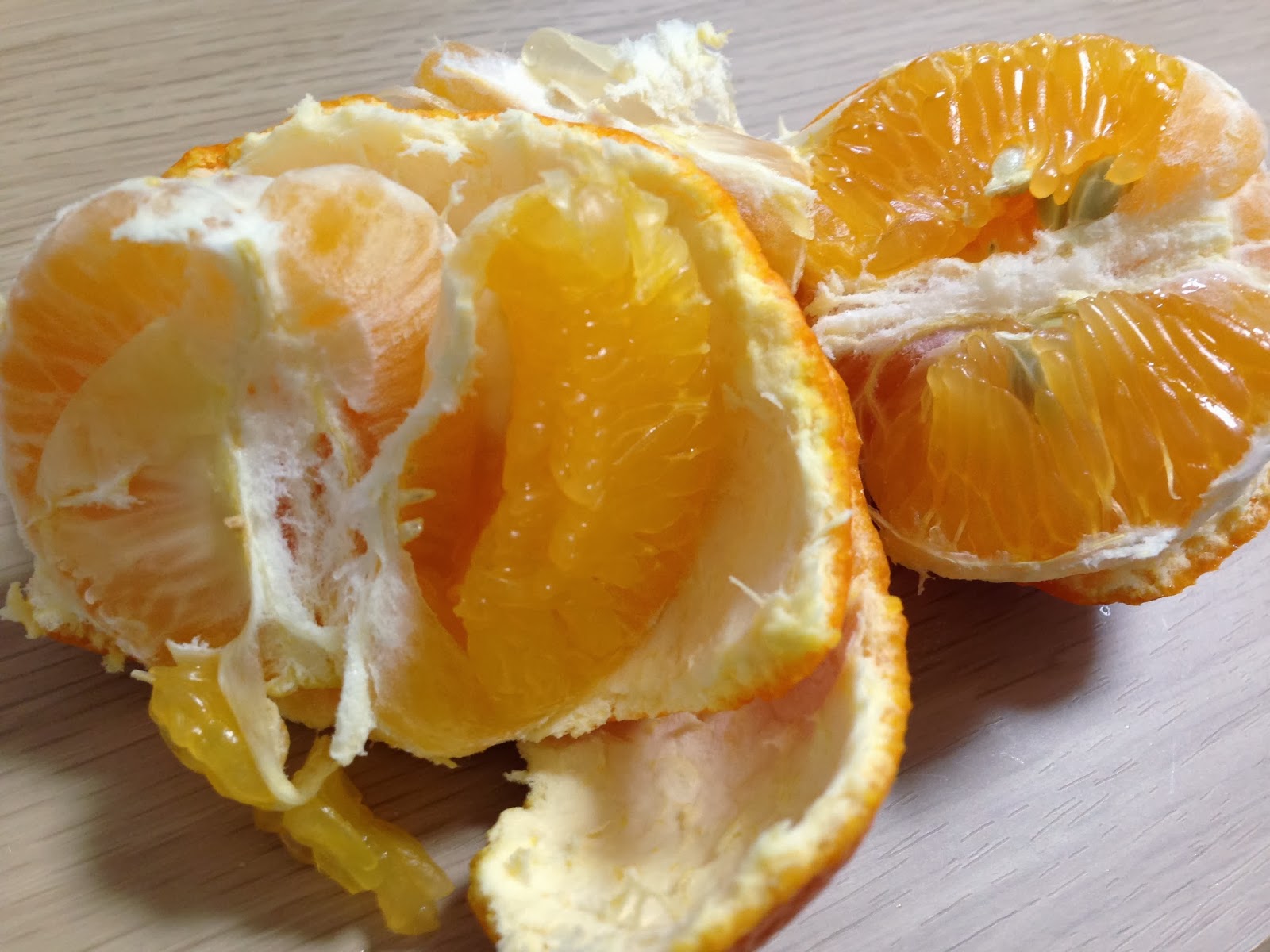
It's NOT an orange, mind you! It's an iyokan!

I first heard about iyokan citrus fruits while on vacation at Dogo Onsen hot springs in Matsuyama, Ehime Prefecture. While cooling off after my bath, the attendant served me an icy cold bottle of Pom brand orange juice.

"This is NOT orange juice," she retorted. "This is special iyokan juice from Matsuyama!"

Though it tasted exactly like orange juice to me, it had the perfect balance of sweet and sour, with a clean, neutral aftertaste. I became such a fan of the fruit that I ended up buying on impulse two extra bottles for the road and 2,000 yen worth of Hello Kitty iyokan plastic souvenirs. (Now that I think about it, that was a little much).


Digging into my first-ever fresh iyokan! YUM!!


This year, I'm fortunate enough to live in the Chugoku region of Japan, where every island and exposed hilltop has some sort of citrus grove atop it. I decided to give my mikan  (easy-peel tangerine) habit a break and try something new. The most noticeable difference between the iyokan and any other orange-like fruit I've tasted was the intense fragrance of the essential oil spraying all over my table while tearing off the peel. The impact was more floral than sweet. Though the iyokan looks as if it would be bitter compared to other oranges, it had a sweetness comparable to a Valencia orange. My husband and I enjoyed the natural citrus perfume that remained on our hands even after washing them with soap!

Just in time for flu season, iyokan are at their peak this time of year. Nothing like fresh, vibrant flavors to keep the body awake and healthy while we anticipate the songs of spring!  

Copyright 2014 Genkilee, Gen. All rights reserved. No part of this blog (written or photo content) may be reproduced or reprinted without the expressed permission of the author.


Saturday, February 8, 2014

1. 東風解凍, "Easterly Winds Melt the Ice"

(BGM: "Winter" by Tori Amos)

Shichijuni-kou (72 Seasons) Calendar Listing
初春, Shoshun,  Early Spring
Season No. 1:立春, Risshun: "The Beginning of Spring"

Snow melts in Yogo, northern Shiga Prefecture.

 
Climate No. 1: 東風解凍, Higashi Kaze Kouri Wo Tokeru
"Easterly Winds Melt the Ice" (February 4-8) 


I personally love this week in the old solar calendar! Without fail, every sadistic meteorologist on Japanese TV will make the eyes of the nation roll in unison by saying that spring has "officially" arrived. Though the coldest winds of the year rage outside, making everyone reach for their kairo instant hand warmer packs, this tidbit of outdated trivia is supposed to make us all feel hopeful, somehow.

True, we've had maybe two days where we didn't need to bundle up so tight. And perhaps that's from an eastern warm front. But nighttime temperatures are still dipping just below zero degrees, making for frosty mornings and chilly days. It ain't spring yet!

But even in this bleak season of struggle, Nature decides to throw herself a little party to brighten the mood.

Flowers of the Season: Plum Blossoms

"Spring too, very soon!
They are setting the scene for it--
Plum tree and moon." -Matsuo Basho (1644-1694)

Snow Melting on a hakubai  (white) Prunus mume

Pink koubai  blossoms of Kyoto's Kitano-Tenmangu Shrine


One has only to look outside and smell the fragrant plum blossoms to feel the joy of spring's arrival. Across Japan, oblivious to the relentless cold in an act of sheer defiance, Prunus mume trees push out their flowers like thousands of mini pompons. Spreading and falling like suspended fireworks, their blossoms give a powerful splash of color to the dry, muted landscapes of winter.

An intensely fragrant roubai (wax apricot) graces the Takehara countryside (Hiroshima Prefecture).
These ornamental Japanese apricots (popularly known by their English misnomer "plum") come in three different colors: 白梅 hakubai  (white), 紅梅 koubai  (lit. "red," but actually pink) and  蝋梅 roubai ("wax apricot," but known as the "yellow plum" even though it's really Chimonanthus praecox, a different species from Prunus mume).

A bright magenta koubai in Hikone (Shiga Prefecture)

Taste of the Season: 蕗の董, Fukinotou, Japanese Butterbur


There's a saying in Japan that in order to become an adult, one must taste the "bitterness of life." Symbolic of this sacrifice is the eating of bitter plants such as butterbur (Petasites japonicus, aka "bog rhubarb"), the first flower of early spring.

Fuki, like its cousin rhubarb, is a wild plant found on Japanese mountainsides. The stalks are usually steamed, boiled or simmered in a broth and served as a side dish. But the puffy bulbous flower buds, once eaten as a standard mountain vegetable, are nowadays considered a seasonal delicacy. 

Coated in a simple tempura batter and deep-fried in cooking oil, butterbur has a gentle nuttiness that overrides any bitter aftertaste. Though the mature stalks of the fuki  (butterbur) plant can be easily located in the local produce section of any grocery store, butterbur flower buds (like the ones pictured here found in Hikone, Shiga) are becoming a rarity in modern chain store supermarkets, as demand for this traditional food is on the decline.

But their warm flavor and chewy, brussel sprout-like texture are worth the extra effort in hunting them down. I found the taste undeniably "green," which always inspires me into thinking about spring.


Copyright 2014 Genkilee, Gen. All rights reserved. No part of this blog (written or photo content) may be reproduced or reprinted without the expressed permission of the author.