Showing posts with label H. Early Autumn. Show all posts

Saturday, September 6, 2014

42. 禾乃登: "Grasses Go To Seed"

(BGM: Appelle Mon Numero by Mylene Farmer)


Shichijuni-kou (72 Seasons) Calendar Listing
初秋, Shoshu: Early Autumn
Season No. 14: 処暑, Shosho
The Limits Of The Heat

Rice kernals plumping under the watchful gaze of Jonenji Temple (Takehara, Hiroshima).

Climate No. 42: 禾乃登
Kokumono Sunawachi Minoru
Grasses Go To Seed
(September 2 -September 6) 

Before I learned about the Shichijuni-ko calendar, I always took the grasses beneath my feet completely for granted. Now that I'm more aware of these essential members of our biosphere, I can enjoy them from a whole new perspective. A typical patch of weeds by the roadside becomes a universe of textures and colors. Apparently my favorite haiku poet experienced a similar fascination with the most overlooked of our fuzzy, tufted friends.

The sun tucks itself behind Mt. Ibuki after an early harvest (Hikone, Shiga 2012).

 "So many grasses
  Each with its own
         Brilliant blossom."   -Matsuo Basho

Flower Of The Season: コスモス, Kosumosu, Cosmos

Triumphant cosmos brighten an Ohmi Hachiman flower field (Shiga Prefecture 2012).

Cosmos originate in the Americas but the Japanese love them as if they were native to the archipelago. Every year I get asked if there are cosmos where I come from, and every year I have to break a few hearts with my reply. The locals use cosmos as a rotation crop, painting the landscape in washes of pink, magenta and green.

Cosmos field in Higashi Ohmi, Shiga Prefecture (2012)

Critter Of The Season: イナゴ, Inago, Locusts

"Hitchin' A Ride" (Nagahama, Shiga 2012)

I have pleasant memories of leisurely cycling down the endless bike trails of southern Ibaraki's Tone and Kokai rivers. Almost like clockwork, during the first week of September, the trails become litered with hundreds of leggy green locusts warming themselves up on the asphalt. Sometimes they're paired up and can't maneuver efficiently away from my tires, the poor male being thrown onto his back as the female tries to escape into the grass with a pitiful flop. It's a good time to practice my steering, to say the least. Fortunately, I haven't hit any, yet.

Up close and personal with Mr. Greenlegs. (Fujishiro, Ibaraki 2003)

Inago (locusts) fried in oil, mirin and soy sauce are a regional delicacy in prefectures like Ibaraki where rice is a major crop. Back in the days when I would try almost anything for novelty's sake, I once crunched on a spoonful of inago no tsukudani . It had the texture of Cajun popcorn shrimp and the flavor was a cross between potato chips and Vietnamese peanut sauce -definitely something I would call 'delicious.' I can easily see why much of the world's inhabitants consider these insects 'good eating.' But as tasty as they are, I'd much rather see them sunning on the bike trails instead of on my plate.

Critter Of The Season: 海蛍, Umi Hotaru, Sea Fireflies


"Small Life, Big Light" (Mihara, Hiroshima 2014).
My brother once spoke of bioluminescence in the waters off the coast of Alaska. I never dreamed I'd be lucky enough to see such a living miracle with my own eyes while in Japan. But surely enough, while talking the sun down with my Hubby and a dear friend from England, there on the beach glowed an eerie electric blue light, streaking in time to the gently breaking waves. I bent down to touch it and the tiny lifeform leaked a luminous fluid, as if someone had broken a glow light tube. I gently picked it up along with its clump of wet sand and inspected the phenomenon with a flashlight; it looked exactly like a kernal of translucent shortgrain rice, but only half the size (and probably not as tasty. I'm terrible. I know).

Playing with sea firefly light trails using the Slow Shutter (TM) app.

Sea fireflies, aka Vargula hilgendorfii, inhabit the clear crystal waters of Japan's Seto Inland Sea, snoozing in the sand by day and darting up to the surface by night to feed. The first week of September is peak season for viewing these aquatic magicians of light. I've heard tales of locals swishing around in the waves causing millions of sea fireflies to illuminate the seawater like a neon sign. But I've only seen scatterings of these tiny creatures floating solo with the flotsam, washed up on the shore like lost sailors in the moonlight.  Oh how my imagination races when I spot one! What an amazing world we live in, where lifeforms grow and glow! Just imagine what else is out there! :-)

Copyright 2014 Robynn. All rights reserved. No part of this blog (written or photo content) may be reproduced or reprinted without the expressed permission of the author.


Monday, September 1, 2014

41. 天地始粛: "Heaven & Earth Begin To Cool"

(BGM: "Ton Amour Ocean" by Anggun)

Shichijuni-kou (72 Seasons) Calendar Listing
初秋, Shoshu: "Early Autumn"
Season No. 14: 処暑, Shosho
"The Limits Of The Heat"

One Last Dip (Namiki Cafe, Kure, Hiroshima)

Climate No. 41:天地始粛
Tenchi Hajimete Samushi
"Heaven & Earth Begin To Cool"
(August 28 -September 1) 

The clash of warm and cool air fronts bring dramatic skies over Mihara, Hiroshima.
"In this place
  All that meets the eye
             Is cool."   -Matsuo Basho

The summer was relatively cool compared to those of the past decade. But nights that don't make you wake up in a pool of sweat are always welcome, no matter how early in the year they arrive. The seasonal autumn rain front is hovering over the Philippines while a cold air mass from Siberia muscles its way over the country, giving us soft, breezy mornings and comfortable night air. We'll take it! 

Flower Of The Season: ナデシコ, Nadeshiko, Large Pink (Dianthus)


A wispy, frilly dianthus blossom graces a seaside cliff at Uratomi Kaigan. (Tottori Prefecture)
These spindly, delicate relatives of the carnation blush year-round in flowerpots from Honshu on south, saving their last blooming hurrah for the first few weeks of September. Nadeshiko's soft, spicy fragrance is reminiscent of warming cinnamon and vanilla, making one thirsty for coffee (well, me at least). They tend to thrive on winding mountain roadsides with plenty of rain and good drainage. (Not to be confused with Yamato Nadeshiko, the epitomy of Japanese beauty and femininity, although the flower sure would pass for it). 

Taste Of The Season: 葡萄, Budou, Grapes


A prize bundle of juicy grapes straight off the vine. (Sakurai Grape Farm, Kasumigaura, Ibaraki)
Before coming to Japan, the only grapes I ever knew were light green muscats imported from the Lower 48 that tasted nothing like the sickeningly sweet concoction known as "grape juice" sold in American supermarkets. Because of this discrepancy, I always thought the "grape" flavor of manufactured foods was an exaggeration for American tastes. (After all, we Americans like our flavors strong, right?)

Too many to choose from! (Sakurai Grape Farm, Kasumigaura, Ibaraki)
But one fateful bite into a cloudy, superball-sized kyoho grape and the water of my imagination had turned to wine. Each explosion of the sticky juice in my mouth was like a holy communion of flavor and joy. No wonder these were the favorite fruit of the Gods! I'd seen the light!

The pleasures of eating grapes right off the vine can be had for about 1000 yen and up at orchards and farms that feature budougari (ぶどう狩り, grape-picking). Sometimes there's a limit, but usually one bunch of these globular treats is enough to satisfy (less if your digestive system is over-efficient). Sitting in a clump of soft chickweed and grass, popping grapes like Dionysus under a canopy of floppy green leaves makes for a heavenly afternoon out of the sweltering sun.

Critter Of The Season: クラゲ, Kurage, Jellyfish

The official end of summer lingered only days away on the calendar and I realized that I never took the chance to swim in the Seto Inland Sea like I had promised myself. Fortunately for me, the humidity was still high enough to make late afternoon temperatures linger a few hours around 27C, just warm enough for a light dip before sunset. My summer didn't have to come to a close just yet!

But I noticed that even on the hottest days that week, though the seas were still as warm as they would be in July, nobody was out there in the water except me.

"It's because you're swimming after Obon," a friend told me. "Only crazy people swim after Obon." (Gulp!)

According to legend, once the spirits are sent out to sea during Obon, the waters become particularly dangerous. And woe to the poor swimmer who fails to heed warning: they risk being dragged down to their watery graves.

Not afraid of ghosts and relatively read-up on marine science, I was about to find out the real reason why people don't swim after Obon and it had more to do with invertebrate blobs of goo than aquatic undines. I didn't notice anything until I got home and did a second rinse in fresh water when I felt a burning, throbbing line of raised welt along the nape of my neck. Some hapless moon jelly had grazed me as I swished in the flow of things.

I showed the welt to our local drugstore pharmacist and he confirmed with a giggle that it was indeed a moon jellyfish lovebite, and he knew I'd been swimming after Obon. (Tisk tisk!) With a quick dab of extra-strength Muhi and lycra thermal underwear over my swimsuit, I was back in the water, happy as a clam with a whole extra month to float in wet, weltless bliss. 

Moon jellies might drift closer to shore as seawater temperatures plummet. But they honestly, I'm certain, don't give a flying fish if it's Obon or not. ;-)

A tank full of innocent-looking moon jellyfish. (Oarai Aquarium, Ibaraki)
Copyright 2014 Genkilee, Gen. All rights reserved. No part of this blog (written or photo content) may be reproduced or reprinted without the expressed permission of the author.

Wednesday, August 27, 2014

40. 綿柎開: "Cotton Flowers Open"

(BGM: "Sayonara Natsu No Hi" by Yamashita Tatsuro)

Shichijuni-kou (72 Seasons) Calendar Listing 
初秋, Shoshu: "Early Autumn"
Season No. 14: 処暑, Shosho
"The Limits Of The Heat"

Poufs of homegrown cotton decorates an autumn wreath woven by a friend of mine.
Climate No. 40: 綿柎開 
Wata No Hanashibe Hiraku
"Cotton Flowers Open"
(August 23 -August 27) 

The gradual setting in of dry, crisp evening air causes cotton and other seed pods to split and pop open with a snap. On my morning walks, I notice the grass beneath my feet has changed from the lush, vivid green I took for granted to a rusty, tired mat of ochre and tan. Jumping spiders and tiny grasshoppers dash out of my way as I swish through. It's easy to see that despite the heat of the noonday sun, for some species, summer is over and the race to procreate before the frost is in full swing.

Flower Of The Season: 紅葉葵, Momiji Aoi, Scarlet Rose Mallow


A mammoth scarlet rose marrow sways in front of an old country home in Shiga.
This towering member of the hibiscus family can easily grow up to seven feet tall and beyond. I'll never forget the first time I saw one of these comically large mallow blossoms. Thinking it was a child's pinwheel, I had to touch it to make sure it wasn't made of plastic! We know Hibiscus coccineus in the US as Texas star or lone star hibiscus. This flower isn't native to Japan by any means, yet it can be found teetering to and fro in neighborhood gardens from Honshu to Kyushu. Despite its other common name marsh hibiscus, H. coccineus apparently grows in much drier conditions like roadside ditches and along inner city driveways, where I often see them. The racy, bold blossoms of H. coccineus add a tropical touch to any landscape -Nature's final summer fling.

Taste Of The Season: 赤唐辛子, Akatougarashi, Red Chilies

"Crimson pepper pod
  Add two pairs of wings 
   And look! 
    Darting Dragonfly!"   -Matsuo Basho

Chilies drying in the early autumn sun (Shigaraki No Sato, Koka City, Shiga Prefecture).
Native to the Americas, Capsicum annuum first made its way into Asia via Portuguese traders during the 16th century. Powder made from the dried fruit of this plant, mixed with other spices in a formula called shichimi togarashi (七味唐辛子, lit. "seven flavors chili pepper") has been around since the Edo period. Fortunately for us, so have some of the shops that first perfected this classic Japanese condiment!

Passing by Kyoto's famous Shichimiya Honpo shop on Sannenzaka Slope (2004).
In my travels, I've not seen red chilies used in everyday cuisine beyond a flavor spike for pickled vegetables or as a sprinkled topping on soba noodles. Maybe I'm not looking hard enough. Bottles and jars of shichimi sit half-filled on just about every restaurant table I've ever sat at, so somebody must be using the stuff. I'm just never lucky enough to catch anyone in the act of sprinkling it on their food besides me.

A fragrant bowl of shichimi powder in a farmer's market cafeteria (Shiobara, Tochigi 2007).
Shichimi is one of those spice combinations that doesn't go with just anything the way other chili pepper powders do. The average shichimi is blended with nutty sesame seeds, dried citrus rind and sansho peppercorns to sweeten it, which substantially limits the spice blend's versitility. I've personally found shichimi to go best with savory, oily foods like ramen, soba soup broth and gyoza (fried dumplings). It tends to easily overwhelm tastebuds that have been sensitized to the subtleties of Japanese cuisine. But when the flavors work well, the effect is pure magic. (Straight-up, unblended akatougarashi, in either powder or dried pod form, is more appropriate for recipes that require the heat of chili peppers without additional flavors).

A very kind and genki (vibrant) shichimi vendor (Kusatsu Hot Springs, Gumma Prefecture, 2004).
But more often than not, especially this time of year, I see chili pepper advertised as a slimming agent in bath salts, body scrubs and as a major component in pain relief patches. Japanese women and the elderly are very familiar with the ancient practice of taking togarashi to improve blood circulation and aid digestion. It's not uncommon to see shichimi shops dotting hot springs and temple towns such as Kusatsu in Gumma prefecture and Tokyo's Sugamo district. Shichimi is the prescription of choice for health and genkiness (vitality), both cooling in summer and warming in winter. As the old Hippocrates saying goes: "Let food be thy medicine and medicine be thy food."

Critter Of The Season: とんぼ, Tombo, Dragonfly

An akiakane (Sympetrum frequens) rests on a weathered bench (Toride, Ibaraki 2010).
These swirling, dipping masters of flight are so dear to me that I don't even know where to begin. My first encounter with Japanese dragonflies was a complete surprise to say the least: I was walking down a crowded Sapporo street headed for the famous Ramen Yokocho when I noticed people pointing to my chest and giggling. I looked down and there on my lapel, perfect as a beaded brooch, sat a lovely scarlet dragonfly, its iridescent, honeycombed eyes staring up at me almost wistfully. Smiling, I walked a whole 'nother block with that critter on my jacket, proud to wear such a glamourous piece of spontaneous living jewelry. As I was about to turn the corner, I looked down again and it had flown off. But for some reason, I felt blessed.

Making friends with the akiakane dragonfly.

Japan has around 200 species of dragonfly, coming in nearly every color of the rainbow, from yellow to purple. But the akatombo (red dragonfly) is the quintessential insect of autumn, swarming around parks and parking lots by the hundreds, especially in areas where rice paddies are prevalent. But as we've been seeing with swallows, fireflies and other creatures dependent on natural watershed habitat, the number of akatombo dragonflies has been decreasing with the loss of rice paddies nation-wide. The more the Japanese diet slowly changes from locally-grown rice to processed wheat products like noodles and bread, the faster the rice paddies disappear. In the meantime, more territorial, brownish-colored akiakane dragonflies like the one here perched on my finger have overrun much of akatombo's habitat.

I've only seen the beautiful, blood-red akatombo three times in my life and I'd love to see more. So over the past few years, I've made it a point to keep Japanese rice as my primary staple food. We do what we can for the environment, right?

Copyright 2014 Genkilee, Gen. All rights reserved. No part of this blog (written or photo content) may be reproduced or reprinted without the expressed permission of the author.

Friday, August 22, 2014

39. 蒙霧升降: "Thick Fog Descends"

(BGM: "Yogiri Yo Konya Mo Arigatou" by Ishihara Yujiro)

Shichijuni-kou (72 Seasons) Calendar Listing 
初秋, Shoshu: "Early Autumn"
Season No. 13: 立秋: Risshu
"The Start Of Autumn"

Moody morning fog after a late night's thunderstorm (Mt. Noro, Hiroshima Prefecture).
Climate No. 39: 蒙霧升降 
Fukaki Kiri Matou
"Thick Fog Descends"
(August 17 -August 22) 

More misty magic on a Mt. Noro bike trail (Kure, Hiroshima).
We've been having tremendous downpours and thunderstorms nearly every day this week. Ignoring the prefectural mudslide warnings, we headed out one morning to drive up our favorite extinct volcano and found ourselves enshrouded in dense, white fog flowing up and around us, so thick I could feel the tiny beads of water collecting on the fine hairs of my lower arms. There's a pleasant expression in these parts for being bathed in this kind of mist: "forest bath" (Jpn: 森林浴, shinrinyoku). Hubby said he felt like passing out, the air was so pure. I found myself getting buzzed on the cleansing, camphor-like fragrance oils of cedar and pine sap that were carried on the mist. The sensations were a hundred percent worth the risk of getting up there. Free aromatherapy!

Flower Of The Season: 木槿, Mukuge, Rose of Sharon (aka Rose Mallow)

A slightly faded Rose of Sharon after a noon rainfall (Takehara, Hiroshima).
I'll never forget the first time I asked about the Hibiscus syriacus, which are blooming everywhere around me, now. These tall, broad-leaved shrubs with bright, floppy flowers resemble hibiscus to a tee. They even have the Latin classification of hibiscus. But the average Japanese granny on the street will adamantly tell you that the mukuge is definitely not a hibiscus. According to Japanese taxonomy, the mukuge is classified as a type of hollyhock.

(Sigh). Here we go again. 

Last year, after it dawned on me that the folks around here don't really care for people who are sure of their knowledge enough to argue about beautiful things like flowers, I learned to simply push aside my need to be correct. It's much easier to learn to enjoy the differences in thought than to resist them. My Korean husband knew nothing of the mukuge's classification, but said he cherished it as his national flower and a symbol of eternity and abundance (Hangul: 무궁화, mugunghwa). I found his attitude of humility refreshing, though I was perplexed at how a plant with flowers that last only a day could symbolize eternity.

(I guess some tasks, like resisting the urge to ask questions, are easier said than done. My, aren't these flowers lovely?!)

Rose of Sharon blossoms permanently folding up after their one day in the sun.

 Taste Of The Season: 蛸, Tako, Octopus

Sweet, savory octopus samples at Nishiki Market in Kyoto (2002).
When I lived in Alaska over a decade ago, the only octopus anything we could enjoy commercially was either in nigirizushi (finger-pressed sushi) or small packages of boiled unborn octopus fried in Korean BBQ sauce from our local Asian market. Alaska is blessed with large populations of edible octopus in her oceans but culturally, octopus was one of those "iffy" foods reserved for the brave. You'd have to go directly to a fisherman to buy one of these heavy, writhing cephalopods, since they're mainly used by Alaskans as bait for catching halibut (a gigantic species of flatfish). Low demand ensured you could never find fresh octopus at supermarkets like Fred Meyer's or Safeway.

Tentacles of suitcase-sized, fresh-caught octopus (Jagalchi Market in Busan, South Korea, 2005)
When I arrived in Japan, I was dazzled by the myriad ways octopus was used in everyday cuisine: stewed, pickled, fresh in sashimi, boiled and chilled in salads, dried and sprinkled on top of piping hot rice -countless options! The springy, rubbery flesh and mild, salty taste of octopus in season goes perfectly with the bitterness of late summer cucumbers, their most common flavor companion.

The octopus is said to be one of the most intelligent creatures of the sea, able to figure its way out of all kinds of mazes, puzzles and traps. Long ago, however, the Japanese figured out the invertebrate's love of hiding in small spaces and devised a deceptively simple contraption for catching them: a baited cyllindrical clay pot lined with a mesh net and a trap door. These takostubo (蛸壺, octopus pots) can be found piled and stacked up against seawalls in cities all along the Seto Inland Sea, where octopus is part of the local daily diet. Just looking at these pots helps me to remember the warm seas of summer.

"Octopus traps
  Fleeting dreams
   Under summer's moon." 
                           Matsuo Basho

Octopus traps (Tomonoura Town in Fukuyama, Hiroshima).
Copyright 2014 Genkilee, Gen. All rights reserved. No part of this blog (written or photo content) may be reproduced or reprinted without the expressed permission of the author.

Saturday, August 16, 2014

38. 寒蝉鳴: "Cicadas Chirp"

(BGM: "A Change Will Do You Good" by Cheryl Crow)

Shichijuni-kou (72 Seasons) Calendar Listing 
初秋, Shoshu: "Early Autumn"
Season No. 13: 立秋: Risshu
"The Start Of Autumn"

Two aburazemi cicadas locked in a mating embrace (Izumo, Shimane, 2014).
Climate No. 38: 寒蝉鳴
Higurashi Naku
"Cicadas Chirp"
(August 12 -August 16) 

An aburazemi taking in the view of the Hirata River from a sakura tree (Hikone, Shiga).

"Now look at me
  In a fine summer robe
   A cicada kimono."  
                            -Matsuo Basho

An aburazemi (Graptopsaltria nigrofuscata) enjoys a moment of quiet repose (Toride, Ibaraki, 2010).
Cicadas are hillarious. They ditz around wrecklessly in the air, whining a weary, straining screech, completely unaware of where they're headed. Sometimes, they bump into walls or people, landing flat on their backs where they stay until death takes them (or until cicada-lovers like me turn them rightside-up). The smarter cicadas whir, chirp and rattle relentlessly in the early autumn heat until they either get their mate or die trying. Their large, frog-like eyes don't seem to be able to serve them well at all, as they're easily confused by bright city lights that compel them to sing in the middle of the night -a most unwelcome sound when it's too hot to sleep.

A cicada serenades me on my patio at night, confused by my kichen light.
But I don't mind. The truth is, I love these bumbling beasties. I'm really fascinated by their power of concentration and no-nonsense personality. Cicadas don't really scuttle around and investigate like typical fully-sentient insects. Rather, once they land somewhere they pretty much stay put, not moving a muscle until it's time to either make some noise or fly off. Yet when disturbed, they make the most ungodly, shrill scream that can scare the bejeezus out of anyone. Though I know they won't hurt me, if I see one helpless on its back, I try to gently overturn it with a stick just because the screech is so darn creepy!

Japan has several species of cicada but the most common seems to be the large navy blue aburazemi cicada (pictured above). This particular species is also the most photogenic, since most of my shots are of them. Their clicking, spinning song is the quintessential theme of summer; it's one of those sounds that makes you feel hot when you hear it instead of cool. The annoying pitch and painful decibel level (over 90 dB) of an aburazemi song just adds to the misery of a pounding, overheated head. And just when you think one is enough, walk down the streets of Shinjuku, Tokyo on any hot August day and the noise is literally deafening!

An irridescent, greenish higurashi cicada on a signpost in downtown Shinjuku, Tokyo (2002).
I personally find the song of the higurashi cicada much more tolerable, if not enjoyable (mainly because I can somewhat mimic it and get them to answer back). Fluttering their abdomens and wings in exciting rhythmic patterns, the higurashi really sing up a storm. (I'm sure if I were a female cicada, I would dig it). In Japan, cicadas symbolize evanescence and reincarnation, apparently from the unearthly way the nymphs crawl out from holes in the ground and up the tree or pole on which their egg was laid. From a few feet up the trunk, the nymph simply freezes as motionless and hard as its personality and a new adult wriggles and bursts forth from the papery exoskeleton, much in the same way dragonflies and other water borne insects do. I was lucky to catch an emergence in progress while taking a night stroll in Shiga, during an Obon lantern festival -a most appropriate celebration of transformation for the Festival of Souls. 

A sticky, brand-new cicada emerges from its old self (Keyaki no Michi Park, Hikone, Shiga).
Kids big and small around the country come out this time of year with cheesy-looking bamboo nets, trying to catch and shove these poor critters into cheap clear plastic boxes for the last few remaining days of their short, noisy lives. It's probably a better way for the bugs to go than to crunch under the heavy foot of some careless salaryman staring at his iPhone on his way back from lunch. No matter. Global warming is making certain that the cicadas will come back in greater numbers every year. In the meantime, I'll be turning over as many as possible to ensure this happens. (I like natural music. So sue me).

One helpful word: earplugs. ;-) Good night from Japan. 

Copyright 2014 Genkilee, Gen. All rights reserved. No part of this blog (written or photo content) may be reproduced or reprinted without the expressed permission of the author. 

Monday, August 11, 2014

37. 涼風至: "Cool Winds Blow"

(BGM: "Together Again" by Janet Jackson)

Shichijuni-kou (72 Seasons) Calendar Listing 
初秋, Shoshu: "Early Autumn"
Season No. 13: 立秋: Risshu
"The Start Of Autumn"

An indigo noren curtain catches the breeze in the front door of soba shop (Matsue, Shimane).
Climate No. 37: 涼風至
Suzu Kaze Itaru
"Cool Winds Blow"
(August 7 -August 11) 

We all wait for nighttime, when it feels as if the door to the heavens has literally cracked open, allowing us a breath of the sweet, cool air flowing in. The daytime sunlight is still painfully strong and biting, but the hours around high noon bring a more tolerable warmth. We don't need the air conditioner except for a few hours a day. (This will help us out a lot since our utility costs are so high this time of year). Evey lungful of early autumn air saves our bodies extra work, giving us more energy for the demands of the festive Obon holiday.

Flower Of The Season: 鬼百合, Oniyuri, Demon Lily (Tiger Lily)

A lovely tiger lily marks the entrance to Koubou Temple (弘法寺) on Mt. Noro (Kure, Hiroshima).
It's as if the universe knew my all-time favorite color combination (vivid green, red-orange, black) and put them in a flower just for me!

A symbol of wealth, the oniyuri (Lilium Maximowiczii) is both a cultivar and wildflower in Japan. In my travels around the country, I've seen it edging roadsides, rice fields and parking lots in the Kanto, Kinki and Chugoku regions, thus far. Yet it's so strikingly tall and graceful that I can't help but think someone must have deliberately put the bulbs into the ground. Literally translated as "demon lily," oniyuri gets its name from both its coloring and demon-like appearance. But instead of striking fear into my heart whenever I see it, the oniyuri uplifts me like no other flower! I always look forward to them when they bloom!

Critter Of The Season: ヤモリ, Yamori, Schlegel's Japanese Gecko

Gecko with eyes glowing from my camera flash (Hikone, Shiga).
If there's any particular creature that helped me to comprehend that I'm now living in a subtropical zone, it's this little guy, Gekko japonicus. Growing up in the subarctic, I'd always associated geckos with places like Mexico or Hawa'ii. I never once dreamed I'd have the good luck of seeing a real one, let alone find a gecko clinging to the window of my Japanese apartment kitchen!
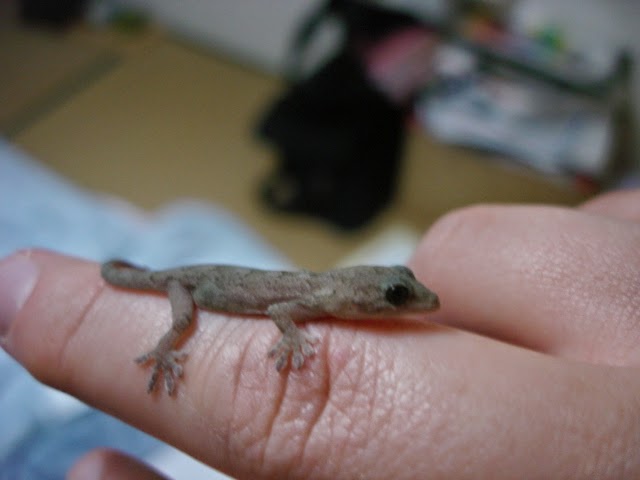
A gecko hatchling I found in my kitchen clings desperately to my warm finger (2007, Ibaraki Pref).
Geckos hide in the cool shadow of wall creases and doorframes by day. But as soon as the porchlights come on, they scuttle up the walls like Spiderman, creeping silently upon their prey (cockroaches, moths, caddisflies, etc.) with all the stealth and skill of a ninja. As with the agile amagaeru (green tree frogs) that have a talent for camouflage, Japanese geckos can go from dark to pale depending on their surroundings. This little dude on my finger changed from a plain concrete grey to this more intricate coloring just in the brief time that I had him inside for a photo shoot.

Their name yamori comes from the words ya (家, house) and mori (守, protect). Young parents will more than likely cringe at the thought of these creatures inside their fancy, high-tec condominiums. But the older generation of Japanese have no qualms letting a few yamori live peacefully inside the walls. (Free, organic pest control!)

Apparently, this species has both a squeaky mating call and an alarm for when they feel threatened. Perhaps my handling technique makes geckos feel too safe to squeal, since I've never heard one freak out, yet. (Hopefully that's the case). But they're quite vocal at night, chirping loudly from building foundations, sounding closer to a rusty bicycle tire in need of a good lube but lacking the acoustic richness of a grasshopper chirp. Nonetheless, I like knowing from the sound that these little critters are nearby, another comforting sound of the season.

Event Of The Season: お盆, Obon, Festival Of Souls

"Not to think of yourself
  As someone who did not count. 
   The Festival of Souls." 
                              -Matsuo Basho

Excited residents of Tone, Ibaraki awaiting sundown and Obon festivities along the banks of the mighty Tone River (2005).
Although I'm of a different spiritual persuasion, I have a great fondness for the Obon festival, that marvelous send-off party for the souls of the dearly departed on their way back to the netherworld. It's not so much the meaning of the ceremony that does it for me, but the way in which the Japanese people so openly and eagerly welcome "outsiders" to partake of these festivities. I can think of no other holiday in Japan where the glass ceiling of racial difference is completely lifted and both Nihonjin and Gaikokujin can dance together as one people under the glittering stars.
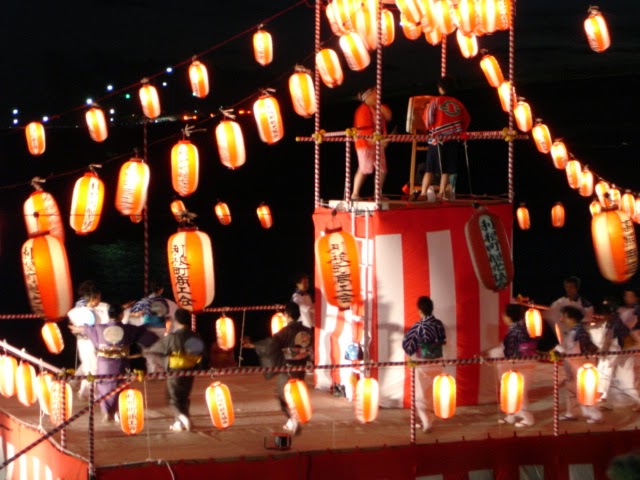
Dancing and drumming on an elevated stage at the Obon Matsuri in Tone, Ibaraki (2005).
You don't have to be a Buddhist or even have deceased loved ones to dance the bon-odori (盆踊り, Obon dance). Nothing matters except that you 1) try your best and 2) have a blast. Hands sway gracefully as you coordinate gentle forward, backward and side steps in a continuous, gradual circle. I always find it easiest to pick a really good dancer a few people ahead of me and concentrate on her/his movements so I don't look like a complete idiot. But everyone is in too good a mood to care, and no matter how hard you screw up the steps, everyone around you will say you're doing great. Besides the droning taiko drums are so heart-pounding, eardrum-burstingly loud that you won't hear anyone heckling!

My mentor gleefully showing me the correct hand position for the Bon Odori dance.

There are many Obon songs out there, some with their own specific motions, so the steps you learn in one town might make you look different in another. But no matter. I'd like to say that you'll get the hang of it quickly, but I never did. Yet it's so much fun to just jump right into the circle and start going for it like it's the last dance of your life, which it very well might be if the humidity and heat are high enough. But working up a sweat in the dance circle is a great way to justify eating all those skewers of scrumptious yatai vendor foods!

Lining up for some sizzling skewered treats!
Some Obon rituals are a bit more reflective and somber, with no yatais, no dancing and the only "music" you hear might be the chanting of Buddhist monks. Actually, most of Obon is celebrated in a close family context: graves and butsudan (仏壇, god shelves) are spruced up and given fresh incense and flowers prior to the arrival of the departed spirits. When the spirit has arrived, a candle is lit and kept lit througout the festival. Families gather, get the spirits up to speed with local news, pay their necessary respects and go to the local hot springs to unwind from a long day's travel. Some people might go to temple for prayers and rites, particularly if souls are in need of soothing. Obon in most sizeable communities usually culminates in a dance party complete with fireworks. But for many others near a river or a large body of water, on the final night of the holiday, the spirits, symbolized by a lit candle, are set adrift to their ethereal home during the Toro Nagashi (灯籠流し, lantern-floating festival).

Just weeks after surviving my own brush with death, I was fortunate to catch the Hikone City Toro Nagashi festival along the banks of the Seri River. In a backdrop of sacred darkness, hundreds of people knelt down at the water's edge and quietly released their lanterns into the gently flowing current with a push and the folding of hands in prayer. The sultry night air was heavy with sorrow that night, as many bid a teary farewell to their loved ones, many who were victims in the Great Tohoku Earthquake earlier that spring. I found myself crying along silently from the opposite bank, finally taking important time to process all the sorrow and loss we'd witnessed when we lived in northern Kanto during the time of the quake. Obon is a much-needed time of emotional release and catharsis in a land where the outward display of emotion is more or less discouraged.

As Paul Simon says, "sometimes, even music cannot substitute for tears."

"Prayers For Safe Passage" (c) 2011 Genkilee, Gen. All Rights Reserved.

Copyright 2014 Genkilee, Gen. All rights reserved. No part of this blog (written or photo content) may be reproduced or reprinted without the expressed permission of the author.